Do You Really Need Scaffolding for That Small Repair? Here’s the Truth
A slipped slate, a small leak or a patch of damaged exterior plaster can look like a quick fix. But if the work is high up, the access plan matters just as much as the repair itself.
Does every small repair need scaffolding? No. But “small” does not automatically mean safe to tackle from a ladder. The right solution depends on the building, the height, the work involved and how our team can reach the area safely.
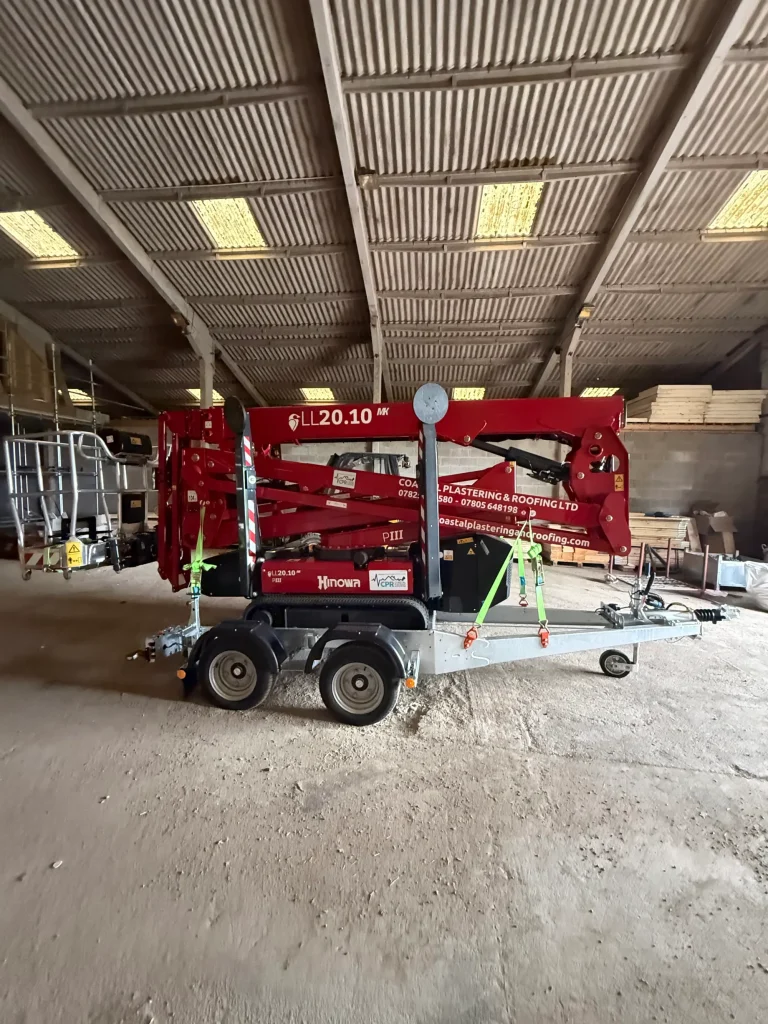
At Coastal Plastering and Roofing Ltd, we provide scaffolding services across Northumberland, and we also use our Hinowa LL20.10 MK spider lift for suitable, isolated jobs. We assess each site and recommend access that fits the task, not a one-size-fits-all answer.
What determines whether a repair needs scaffolding?
The first question is not simply how many tiles need replacing. It is how the work can be done safely.
We consider whether the repair involves working on the roof or can be completed from a protected platform; how long the task is likely to take; whether the team needs to move along the roof; and whether tools or materials need to be carried up. We also look at roof pitch and condition, nearby edges and fragile areas, ground conditions, access to the property, and any risks to people or property below.
A brief repair in one accessible spot may call for a different solution from several hours of work around a chimney. A small patch of exterior plaster might be within reach of a lift, while a larger area that needs repeated access could be better suited to a scaffold platform.
That is why a proper assessment comes first. The best access is the one that gives the team a stable, suitable place to work and protects everyone around the job.
What does the law say about working at height?
In plain terms, UK work-at-height rules require employers and contractors to plan the work, assess the risks and choose suitable equipment. Work at height should be avoided where reasonably possible. If it cannot be avoided, the work needs appropriate measures to prevent falls or reduce the consequences if a fall occurs.
There is no blanket rule that every roof repair must use scaffolding. Equally, a job being quick or small does not remove the need for safe access. A ladder is not automatically suitable just because the work may only take a short time.
For many jobs on a pitched roof, especially work that lasts longer, involves moving around or takes place near an edge: scaffolding with appropriate edge protection can provide the safer, more practical working platform. Other access equipment may be suitable in specific circumstances, but the choice needs to reflect the actual site and task.
A spider lift can provide a working platform for a localised repair, allowing our team to reach the work area from the basket without using a full scaffold around the building. It still needs a site-specific assessment, including ground stability, reach, overhead obstructions, weather and safe operation.
For clear, plain-English guidance, see the Health and Safety Executive’s work-at-height information and its guidance on roof work.
When scaffolding is usually the better option
Access scaffolding is often the right choice when the job needs a stable platform over an extended period or across a larger area. It can be especially useful for:
- Roof repairs that require the team to work along a roof edge or across several areas.
- Chimney, ridge, gutter or other work that needs sustained access.
- Repairs involving a number of tools or materials.
- Projects where several trades need to reach the same elevation.
- Work that needs a protected platform and suitable edge protection around the building.
Scaffolding takes planning, erection and dismantling, but it can provide dependable access throughout a longer project. Our scaffolding services in Northumberland are available for domestic and commercial work, from repairs to larger renovation projects.

When our Hinowa spider lift may be a better fit
For small, isolated repairs, a spider lift may be a practical alternative to full scaffold, if the property and work area are suitable. It can be useful where the team needs to reach one section of a roof or exterior wall, and where a full scaffold would be unnecessary or disruptive.
Our Hinowa LL20.10 MK spider lift gives us a mobile working platform for appropriate high-level roofing and plastering tasks. Its compact design can help with restricted access, but no machine suits every site. The ground must support the equipment, the lift must be able to reach the work area, and the team must be able to operate it safely in the conditions.
The lift does not make every repair faster, cheaper or safer by default. If the work involves broad roof access, multiple elevations or a long programme, scaffolding may be the more suitable option. We compare the task with the site, not just the size of the defect.

If you are searching for plasterers near me to repair an exterior finish, the same principle applies: the access plan depends on the height, extent and position of the damaged area. We can assess whether a lift, scaffolding or another appropriate method best suits the job.
Cost and time: what should you weigh up?
There is no single price for scaffold hire or lift access because every property and repair is different. Instead of comparing one headline figure with another, ask what each option includes and how it fits the work.
For scaffolding, consider the time and scope involved in erection, dismantling and the agreed hire period. Height, property layout, restricted access, roof features and the need for adaptations can all affect the arrangement. If the project may take longer than planned, clarify how extensions or changes are handled.
For a spider lift, consider whether there is enough room to position the machine, whether the ground and route are suitable, how much reach the work requires and how long the equipment will be needed. A lift can be a good fit for a short, localised task, but it is not automatically the better-value choice if the job needs repeated access or several working positions.
Time matters too. A scaffold may take longer to arrange and erect, but provide access over a longer period. A lift may be more direct for a focused repair, provided the site is suitable and the team can complete the work from the platform. We explain the practical options before work begins, so you can make an informed decision without assumptions or surprise add-ons.
For more on what affects a scaffold quote, read our guide to scaffolding hire in Northumberland.
How we choose the right access for your repair
When you contact us, we look at the repair and the access together. We’ll discuss the affected area, assess the property and site conditions, and explain which access method we consider suitable and why. We’ll also outline what the work involves, what could affect timing and what your quote includes.
Whether you need roofing repairs, exterior plastering or a full scaffold, we aim to provide a safe, well-planned service with clear communication from the outset. No project is too basic, complex, big or small: our recommendation will be based on the work that needs doing.
Explore our roofing services in Northumberland or get in touch for advice about your property.
Need advice on scaffolding or a spider lift?
If you’re unsure whether your repair needs scaffolding, we’re happy to talk it through. Coastal Plastering and Roofing Ltd provides reliable access solutions and high-quality roofing and plastering work across Northumberland.
Call us on 07825 616580 or email info@coastalplasteringandroofing.com.
Call for clear, practical advice. | Call for clear, practical advice. | Call for clear, practical advice.
Tell us what needs attention, and we’ll help you work out the next step.